Showing posts with label Astronomy. Show all posts

Sunday, August 17, 2008

Astronomy: A Beginner's Guide

Astronomy: A Beginner's Guide to the Universe (5th Edition)
By Eric Chaisson, Steve McMillan


Astronomy Today 4/e (ISBN 0-13-091542-4) is the more comprehensive text by this: proven team of authors. This twenty-eight chapter text begins with the foundations of the history of science and physics as they relate to astronomy (Part One), then proceeds with an "Earth-out" organization for coverage of the solar system (Part Two), stars and stellar evolution (Part Three), and galaxies and cosmology (Part Four). New with the fourth edition, the book is now available in two paperback splits:

Astronomy Today 4/e: The Solar System (ISBN 0-13-093560-3) covers Part One on foundations (Chapters 1-$); Part Two on the solar system (Chapters 6-15); the Sun chapter (Chapter 16); and the final chapter on life in the universe (Chapter 28).

Astronomy Today 4/e: Stars and Galaxies (ISBN 0-13-093571-9) includes Part One on foundations (Chapters 1-S); Part Three on stars and stellar evolution (Chapters 16-22); and Part Four on galaxies and cosmology (Chapters 23-28).

Astronomy: A Beginner's Guide to the Universe 4/e (ISBN 0-13-100727-0) is the authors' briefer text. It covers the same scope of material in the same order as Astronomy Today 4/e, but with less detail and in fewer chapters (eighteen instead of twenty-eight) and fewer pages.


About the Author

Eric Chaisson. Eric holds a doctorate in astrophysics from Harvard University, where he spent ten years on the Faculty of Arts and Sciences. For five years, Eric was a Senior Scientist and Director of Educational Programs at the Space Telescope Science Institute and Adjunct Professor of Physics at Johns Hopkins University. He then joined Tufts University, where he is now Professor of Physics, Professor of Education, and Director of the Wright Center for Innovative Science Education. He has written nine books on astronomy, which have received such literary awards as the Phi Beta Kappa Prize, two American Institute of Physics Awards, and Harvard's Smith-Weld Prize for Literary Merit. He has published more than 100 scientific papers in professional journals, and has also received Harvard's Bok Prize for original contributions to astrophysics.

Steve McMillan. Steve holds a bachelor's and master's degree in Mathematics from Cambridge University and a doctorate in Astronomy from Harvard University. He held post-doctoral positions at the University of Illinois and Northwestern University, where he continued his research in theoretical astrophysics, star clusters, and numerical modeling. Steve is currently Distinguished Professor of Physics at Drexel University and a frequent visiting researcher at Princeton's Institute for Advanced Study and the University of Tokyo. He has published more than 50 scientific papers in professional journals.

Details
Published on: 2006-03-06
Number of items: 1
Binding: Paperback
576 pages


Reviews

Awesome
The book was just as i expected!!! it was new, no marks, and no bent pages! it was a great price and it looks like i just bought it from a book store!! shipped really fast! THANKS


Friday, August 1, 2008

The Perseids Meteor shower

A meteor shower, some of which are known as a "meteor storm", "meteor outburst", or "shooting star", is a celestial event where a group of meteors are observed to radiate from one point in the sky. These meteors are small fragments of cosmic debris entering Earth's atmosphere at extremely high speed. They vaporize due to friction with the air, leaving a streak of light that very quickly disappears. For bodies with a size scale larger than the atmospheric mean free path (10 cm to several metres) this visible light is due to the heat produced by the ram pressure (not friction, as is commonly assumed) of atmospheric entry . Most of the small fragments of cosmic debris are smaller than a grain of sand, so almost all fragments disintegrate and never hit the earth's surface. Fragments which do contact Earth's surface are called meteorites.

A Perseid (possibly 2) and Milky way

A Perseid (possibly 2) and Milky way

The Perseids (pronounced /ˈpɝsiːɨdz/ pûr'sē-ĭdz) are a prolific meteor shower associated with the comet Swift-Tuttle. The Perseids are so called because the point they appear to come from, called the radiant, lies in the constellation Perseus. Meteor showers occur when Earth moves through a meteor stream. The stream in this case is called the Perseid cloud and it stretches along the orbit of the Comet Swift-Tuttle. The cloud consists of particles ejected by the comet as it passed by the Sun. Most of the dust in the cloud today is approximately a thousand years old. However, there is also a relatively young filament of dust in the stream that boiled off the comet in 1862. The approximate rate of meteors originating from this filament is much higher than normal.


Observation

The famous Perseid meteor shower has been observed for about 2000 years, with the first known information on these meteors coming from the Far East. In early Europe, the Perseids came to be known as the "tears of St. Lawrence."

The shower is visible from mid-July each year, with the greatest activity between August 8 and 14, peaking about August 12. During the peak, the rate of meteors reaches 60 or more per hour. They can be seen all across the sky, but because of the path of Swift-Tuttle's orbit, Perseids are mostly visible in the northern hemisphere.

To experience the shower in its full, one should observe in the dark of a clear moonless night, from a point far outside any large cities, where stars are not dimmed by light pollution. The Perseids have a broad peak, so the shower is visible for several nights. On any given night, activity starts slowly in the evening but picks up by 11 p.m., when the radiant gets reasonably high in the sky. The meteor rate increases steadily through the night as the radiant rises higher, peaking just before the sky starts to get light, roughly 1½ to 2 hours before sunrise.

2007

The Perseid meteor shower peaked on the new-Moon night of Sunday–Monday, August 12–August 13 and could be seen from any place in the northern hemisphere. The Perseid meteors appeared to stream away from their radiant near the border of Perseus and Cassiopeia.

The meteor rate, for an observer at a dark-sky site in the northern temperate latitudes, increases to roughly 30 per hour in the predawn hours on Saturday, 45 per hour on Sunday morning, and 80 per hour before the sky starts to get light on Monday morning.


2008

The Perseids will next be active from July 17 to August 24, 2008, with their peak on the morning of August 12, 2008.


Thank Ref and  Read more...Perseids - Wikipedia, the free encyclopedia, Meteor shower - Wikipedia, the free encyclopedia


Sunday, July 27, 2008

Celestron SkyScout Personal Planetarium

Celestron SkyScout Personal Planetarium

From Celestron


Manufacturer
The SkyScout is a revolutionary handheld device that uses advanced GPS technology with point and click convenience to identify thousands of stars, planets, constellations and more.


Identify
Simply point the SkyScout at any star in the sky and click the target button. The SkyScout will tell you what object you are looking at.

Celestron SkyScout

Locate
To locate a star or planet, select the object's name from the menu and follow the directional arrows through the viewfinder. SkyScout tells you when you are on target. It's that easy!

Learn
Once you have targeted an object the real fun begins. The SkyScout includes entertaining and educational audio and text information, including facts, trivia, history and mythology about our most popular celestial objects. A fun learning tool for all ages, the SkyScout personal planetarium puts the knowledge of an expert astronomer in the palm of your hand.

SkyScout features

  • Identifies celestial objects with the click of a button.
  • Locates over 6,000 stars, planets and constellations from built-in celestial database and provides scientific information for each object.
  • Provides comprehensive text and audio descriptions providing history, mythology and other entertaining information for the most popular objects.
  • Tonight's Highlights: a customized list of the 20 best objects to view for your exact date, time and location anywhere in the world.
  • Constellation lessons: if the star you identify or locate is part of a constellation like the Big Dipper, you can actually take a guided tour through all the stars in that constellation and even see an onscreen map of the constellation.
  • Built-in field guide includes:
    • Introduction to astronomy: a six part audio lesson on the origin and history of astronomy
    • Glossary of terms: text defining popular astronomy terms including planets, comets, galaxies and more
    • Great Astronomers: text bios on some of the world's greatest astronomers including Galileo, Einstein and Copernicus
    • Man-made space objects: text description of some of the coolest objects man has sent into space including the International Space Station, the Hubble Space Telescope and the Space Shuttle
    • Comet guide: text descriptions about history's most famous comets including Halley's Comet and Comet Hale-Bop
  • SD card slot: for optional Sky Tour audio presentations that provide hours of entertainment on a variety of topics
  • USB port: allows database to be updated with new objects as they are discovered, comets, etc.
  • Simple enough for all ages: just turn it on and it's ready to use
  • Built-in help menu: includes a quick start instruction guide for using the SkyScout
  • Bring it anywhere: compact and light design makes it easy to carry and durable construction makes it safe for rugged environments
  • Backed by Celestron's 2-year warranty

Saturday, July 19, 2008

The Black Hole War: My Battle with Stephen Hawking to Make the World Safe for Quantum Mechanics

The Black Hole War: My Battle with Stephen Hawking to Make the World Safe for Quantum Mechanics

What happens when something is sucked into a black hole? Does it disappear? Three decades ago, a young physicist named Stephen Hawking claimed it did-and in doing so put at risk everything we know about physics and the fundamental laws of the universe. Most scientists didn't recognize the import of Hawking's claims, but Leonard Susskind and Gerard t'Hooft realized the threat, and responded with a counterattack that changed the course of physics. THE BLACK HOLE WAR is the thrilling story of their united effort to reconcile Hawking's revolutionary theories of black holes with their own sense of reality-effort that would eventually result in Hawking admitting he was wrong, paying up, and Susskind and t'Hooft realizing that our world is a hologram projected from the outer boundaries of space.
A brilliant book about modern physics, quantum mechanics, the fate of stars and the deep mysteries of black holes, Leonard Susskind's account of the Black Hole War is mind-bending and exhilarating reading.

About the Author
Leonard Susskind has been the Felix Bloch Professor in theoretical physics at Stanford University since 1978. The author of The Cosmic Landscape, he is a member of the National Academy of Science and the American Academy of Arts and Sciences, and recipient of numerous prizes including the science writing prize of the American Institute of Physics for his Scientific American article on black holes.


Reviews

Susskind shines !!
This is absolutely the greatest example of what popular science book about theoretical physics/cosmology should be !! Writing is so brilliant, witty, straightforward, direct and succinct, that regardless of education level, anybody can enjoy interesting content (history of science as well as author's personal story) of "The Black Hole War". Author uses analogies in the best possible way, comparable only to Brian Greene and Michio Kaku. Drawings are frequent, well selected, informative and easy to understand. He writes: "The real tools for understanding the quantum universe are abstract mathematics: infinite dimensional Hilbert spaces, projection operators, unitary matrices and a lot of other advanced principles that take a few years to learn. But let's see how we do in just a few pages". AND HE DELIVERES !! While this book could be a starter for anybody, I recommend it to all who know Kip Thorne's famous work. For reason unknown to me, important black hole "war" is not mentioned in "Black Holes & Time Warps" at all. Professor Susskind created a true masterpiece where he even accepts coexistence of science and faith by writing: "The British intellectual world seems to be big enough for both Dawkins and Polkinghorne". Nothing but big applaud for the author and his effort !!


The history is ultimately written by the winners
Leonard Susskind is not only a co-father of string theory, the holographic principle, and many other key concepts of physics but also one of the most original physicists of our era.
He's been fighting against some superficially plausible but fundamentally wrong ideas for decades. During this ferocious fight, he had to discover many fascinating things about quantum gravity.
The battle was about the preservation of the information by black holes. Using revolutionary but approximate results, Stephen Hawking has argued since the 1970s that the information is lost after a black hole evaporates. Leonard Susskind claimed that it was preserved: this preservation, also called unitarity, is one of the postulates of quantum mechanics and these postulates are and have to be completely universal.
Susskind was right. We know many reasons why it is so, including recent results in string theory, and many of them are explained in the book. We also know loopholes that show that Hawking's old qualitative arguments are not quite correct even though his numerical results are numerically almost accurate.
It took many years for Hawking to understand and admit that the information was preserved in the full theory and that physics makes sense. During those years, Susskind was a new "Ahab" waiting for Hawking's elusive concession. However, the book offers a lot of personal stories and emotions, too. Susskind talks about several well-known names of science such as Stephen Hawking, Gerard 't Hooft, Roger Penrose, and Richard Feynman. All of them, and others, have been players in this fascinating story. [Read on...]


Saturday, July 5, 2008

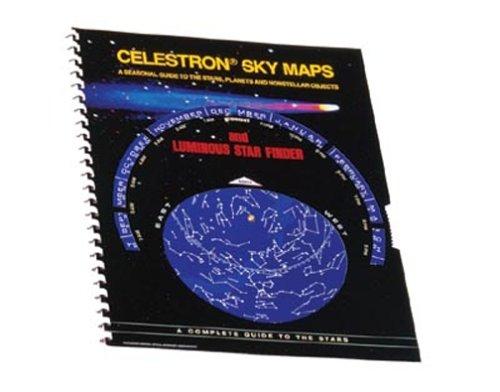
Celestron Sky Maps

The maps are excellent, bought this for my 10 year od daughter and some of the wording inside is a bit beyond her at this time but she can grow into it

Gift recipient said it was great. I can't add any more than that.


Celestron Sky Maps
From Celestron List Price: $24.00
Price: $18.01

Features
Ideal teaching tool for learning the night's sky
Specially designed cover rotates to simulate the seasonal progression of celestial objects
Illustrated reference section provides basic information and the visual characteristics of various types of stars, nebulae and galaxies

From the Manufacturer
Celestron Sky Maps are the ideal teaching guide for learning the night sky. Even if you already know your way around the major constellations, these maps can help you locate all kinds of fascinating objects.

The front cover has a specially designed luminous planisphere that rotates to simulate the seasonal progression of celestial objects through the sky. When the planisphere is preexposed to light, star positions glow brightly against a dark background, mimicking actual constellations. More than 1,000 stars and deep-sky objects are listed and charted. The illustrated reference section provides basic information and the visual characteristics of various types of stars, nebulae, and galaxies.

The maps measure 13.75 by 11.5 inches and are printed on a heavyweight, moisture resistant card stock. The pages have a special comb binding so they can lay flat or be folded over.


Ref: Cheap Telescopes Associates - Celestron Sky Maps


Sunday, June 29, 2008

Interferometry and Synthesis in Radio Astronomy

Interferometry and Synthesis in Radio Astronomy

Interferometry and Synthesis in Radio Astronomy

By A. Richard Thompson, James M. Moran, George W., Jr. Swenson

Book Description

Comprehensive, authoritative coverage of interferometric techniques for radio astronomy
In this Second Edition of Interferometry and Synthesis in Radio Astronomy, three leading figures in the development of large imaging arrays, including very-long-baseline interferometry (VLBI), describe and explain the technology that provides images of the universe with an angular resolution as fine as 1/20,000 of an arcsecond.
This comprehensive volume begins with a historical review followed by detailed coverage of the theory of interferometry and synthesis imaging, analysis of interferometer response, geometrical relationships, polarimetry, antennas, and arrays. Discussion of the receiving system continues with analysis of the response to signals and noise, analog design requirements, and digital signal processing.
The authors detail special requirements of VLBI including atomic frequency standards, broadband recording systems, and antennas in orbit. Further major topics include:
* Calibration of data and synthesis of images
* Image enhancement using nonlinear algorithms
* Techniques for astrometry and geodesy
* Propagation in the neutral atmosphere and ionized media
* Radio interference
* Related techniques: intensity interferometry, moon occultations, antenna holography, and optical interferometry
Interferometry and Synthesis in Radio Astronomy, Second Edition is comprehensive in that it provides an excellent overview of most radio astronomical instrumentation and techniques.


Ref: Cheap Telescopes Associates - Interferometry and Synthesis in Radio Astronomy

Astronomy From Wikipedia

Astronomy
From Wikipedia, the free encyclopedia 
For other uses, see Astronomy (disambiguation).
 
A giant Hubble mosaic of the Crab Nebula, a supernova remnant

Astronomy (from the Greek words astro(αστέρι) = star and nomos(νόμος) = law) is the scientific study of celestial objects (such as stars, planets, comets, and galaxies) and phenomena that originate outside the Earth's atmosphere (such as the cosmic background radiation). It is concerned with the evolution, physics, chemistry, meteorology, and motion of celestial objects, as well as the formation and development of the universe.

Astronomy is one of the oldest sciences. Astronomers of early civilizations performed methodical observations of the night sky, and astronomical artifacts have been found from much earlier periods. However, the invention of the telescope was required before astronomy was able to develop into a modern science. Historically, astronomy has included disciplines as diverse as astrometry, celestial navigation, observational astronomy, the making of calendars, and even astrology, but professional astronomy is nowadays often considered to be synonymous with astrophysics. Since the 20th century, the field of professional astronomy split into observational and theoretical branches. Observational astronomy is focused on acquiring and analyzing data, mainly using basic principles of physics. Theoretical astronomy is oriented towards the development of computer or analytical models to describe astronomical objects and phenomena. The two fields complement each other, with theoretical astronomy seeking to explain the observational results, and observations being used to confirm theoretical results.

Amateur astronomers have contributed to many important astronomical discoveries, and astronomy is one of the few sciences where amateurs can still play an active role, especially in the discovery and observation of transient phenomena.

Old or even ancient astronomy is not to be confused with astrology, the belief system which claims that human affairs are correlated with the positions of celestial objects. Although the two fields share a common origin and a part of their methods (namely, the use of ephemerides), they are distinct.

Thank Ref : Astronomy - Wikipedia, the free encyclopedia

Template by - Abdul Munir | Daya Earth Blogger Template
Cheap Telescopes Associates